Always on
This project successfully funded on 3rd November 2025, you can still support them with a donation.
Crowdfunder is secure
Your payment details are protected
This project successfully funded on 3rd November 2025, you can still support them with a donation.
A photobook by Crystal Bennes about the global fertiliser industry and how our collective appetite reshapes the earth
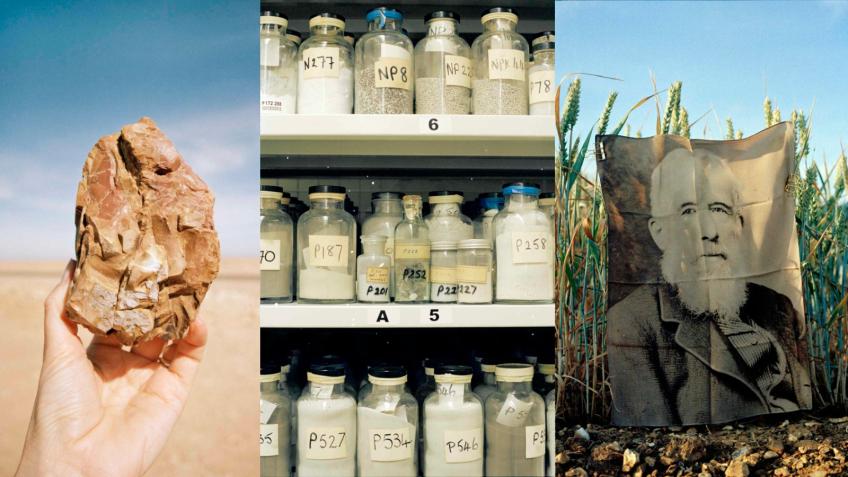
We Eat the Earth is a story about fertiliser. Fertiliser is rarely the subject of public debate, yet it is a material deeply implicated in the climate crisis.
To be published in 2026 as a photobook, We Eat the Earth combines archival images, fieldwork photos and texts to describe how our collective appetite reshape the earth. Using fertiliser as a lens, the project investigates relationships between industrial agriculture, climate crisis, chemical warfare, settler colonialism and extractavism.
We Eat the Earth maps the material flows of fertiliser between seven key sites, including:
By mapping such flows, the project aims to reveal the destabilising global impact of fertiliser production and the devastating environmental and socio- political consequences of its extraction, production and management.
The research also explores possible farming futures without any fertiliser use, visiting a number of farmers in the UK and north Africa who refuse to use fertiliser for political and environmental reasons.
Since 2021, I have self funded almost the entirety of this project, paying for trips around Europe, the UK and north Africa, as well as film and processing time. I have secured a publishing deal with renowned Dutch art book publishers, The Eriskay Connection, to publish We Eat the Earth as my second photobook.
All of the book’s photography has been shot in 35mm and 120mm colour and black and white film, including limited use of a special black-and-white x-ray film.
I have raised £6,500 funding to date. Through book pre-sales, this crowdfunding campaign aims to raise funds to cover the remaining production costs—mainly lithography and printing costs.
Although the book has not yet been designed, the vision is to produce a large book, around 23 x 30 cm, of between 150 and 200 pages. The book will be printed in an edition of 750 - 1,000 copies.
The photobook will largely consist of unique photographic work alongside archival imagery. There will be an accompanying essay written by me on the destabilising global impact of fertiliser and the devastating environmental consequences of its production.
I am a visual artist and writer. My photographic practice critically examines the intersecting threads of environmental extractivism, financialisation, technologies of war, and gendered histories. I have exhibited widely and internationally including at: Noua, Bodø (2025); Gallery Format, Malmö (2025); Noorderlicht Photography Biennial, Netherlands (2025); Freelands Gallery, London (2024); Talbot Rice Gallery, Edinburgh (2024); and Centre Photographique d’Île-de-France, Paris (2023).
In 2025, I am artist-in-residence at the Irish Museum for Modern Art in Dublin. I have twice been an artist in residence at CERN, the European Organization for Nuclear Research (2018, 2020), and between 2022-24 I was a Freelands Foundation Fellow at Talbot Rice Gallery, University of Edinburgh.
My first photobook, Klara and the Bomb, was published by The Eriskay Connection in 2022 to widespread critical acclaim. It was shortlisted for the Photo Text Award at Les Rencontres d’Arles in 2023 and received a special commendation at the Singapore International Photography Festival in 2024.
The book will be published by The Eriskay Connection, a Dutch studio for book design and an independent publisher of art books at the intersection of photography, research, social issues and science. The Eriskay Connection works with local printers and binders. The book will be printed and bound in the Netherlands. Their titles are distributed worldwide and offered through numerous book fairs and other specialist photobook events around the world including Les Rencontres d’Arles, Tokyo Art Book Fair, Polycopies in Paris, Unseen Amsterdam and more.

Creative Scotland Crowdmatch provided £7,000 of match funding
Funding method
Keep what you raise – this project will receive all pledges made