Target reached!
This is our first ever crowdfund, and your support means the world. Meeting our stre...
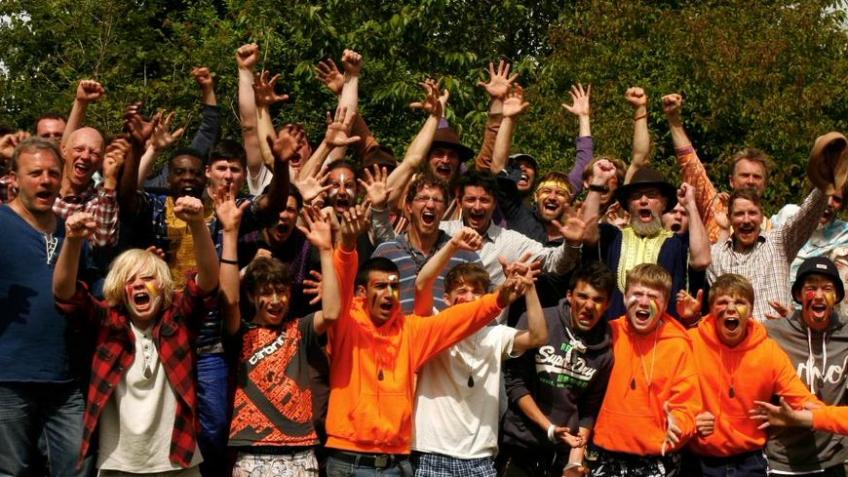
This is our first ever crowdfund, and your support means the world. Meeting our stre...
We want to reach more communities by building our team, improving communications and recruiting more mentors to support more young people.
Journeyman UK has been working with boys, young men and their communities for the last 10 years.
Our vision is to create communities where adults support young men during their transition from childhood to adulthood, thereby increasing their positive contribution to society and equipping them to deal with life’s challenges.
We're a registered charity dedicated to supporting boys aged 13 to 17 in discovering their potential and providing support during challenges. By providing a range of activities, experiential learning, training, mentoring and space for sharing, we enable communities to skilfully take responsibility for supporting their boys and young men become the adults they want to be. We transform men into mentors.
You can read more about us in this Telegraph article published in August 2021.
Why we need your support
We've reached over 200 boys and 350 men over the last 10 years, but we know we can do more. We're at a crucial point in our development and we need funds to grow our central coordination team to support existing groups and develop new ones across the country.
It can take up to £1,000 to set up a new Journeyman Group in a town or city. And we see a future where no town or city goes without a group.
The problems we seek to solve
We've been through too many generations of inadequate mentorship for young boys and at Journeyman we're trying to build the foundations and scalability to support and train men to become the mentors they need to be for our young boys.
Navigating adolescence without guidance often leads boys to make poor decisions, leading to a path of harmful and high-risk behaviour. Many times, boys become confused, angry and feel lost, leading to poor academic performance, disengagement from school and learning, delinquent or violent behaviour, and becoming involved in substance abuse and/or gang activity.
Growing up is tough. For boys, growing up in a single parent home, especially without a father or a male role model, is even tougher. According to the Office of National Statistics (ONS), there are 2.9 million lone-parent families in the UK, which is 14.7% of all families in the UK. Around 90% of those families are led by single mothers, with absent fathers. And according to the Child Poverty Action Group (CPAG), 44% of children from lone-parent families are living in poverty.
A recent study published by the British Journal of Psychiatry found that from a cohort of 19,000 young people, 17-year-olds were asked if they had ever hurt themselves “on purpose in an attempt to end your life”, 7% replied yes. When asked if they had self-harmed during the previous year, 24% responded that they had.
We are seeing boys suffering in schools. Disruptive behaviour like bullying, acting out, truancy, disrespecting authority and classroom disruption can lead to suspension or exclusion from school. Excluded children are the most vulnerable: twice as likely to be in the care of the state, four times more likely to have grown up in poverty, seven times more likely to have a special educational need and 10 times more likely to suffer recognised mental health problems. And boys are significantly more likely to be excluded from school than girls. School authorities rarely have the time or the budget to get to the root of a boy’s problem(s) and the reason for his low academic achievement or negative behaviour. Repeated or permanent exclusion from school is a defining factor in whether an individual is likely to be NEET (not in education, employment, or training) later in life. With the advent of the Covid19 pandemic, there has been a large increase in unemployment for young people aged 14 – 24. From September to November 2020, there was a 17% increase in unemployment for young men (compared with 8% increase for young women).
Due to all these social, family, and economic stressors, many boys grow up with a damaged sense of belonging and self-worth. These are two characteristics that are critical for the formation of a healthy individual. This lack of confidence and self-esteem is devastating developmentally, and is made far worse by the loss or decline of protective factors such as positive male role model involvement, community mentoring and rites of passage.
How we do it
Our work requires a recognition and witnessing of the boy on the verge of stepping into adulthood; a moment where he can be seen and accompanied on the journey of leaving childhood attitudes behind and stepping up to be the man he wants to be, with all the responsibility, courage, and honour that this requires. This is his rite of passage.
True community support for these young men requires ongoing time and connection with adult male role models. They need space to explore and practice their interactions with others. They can learn how to handle conflict, fear, anxiety, responsibility, stress, feelings of shame, joy, anger – the full range of emotions, and what feelings are for and how to work with them constructively.
Using experiential and informal education techniques, Journeyman also teaches critical life skills including: learning to listen and communicate in groups, how to build relationships at home and beyond (regardless of background/class/colour), how to speak up and build self-awareness, how to understand their emotional, cognitive and physical needs/changes. This is achieved through patient mentoring on a regular basis in local groups.
A lot of the work we do revolves around supporting the men who step up to mentor the boys. To be effective adult male role models, we must be willing to explore our own challenges and triggers as men. We emphasise a culture of service and giving as we receive – this is fundamental to the Journeyman way.
It is easier to grow strong boys than to fix broken men.
Journeyman UK has three primary programme offerings – Local regular Groups, Mentoring Groups and Rights of Passage events.

The National Emergencies Trust provided £10,580 of match funding

Sovereign Network Group: Thriving Communities provided £2,000 of match funding
This project successfully funded on 15th December 2021