Always on
This project successfully funded on 17th June 2026, you can still support them with a donation.
This project successfully funded on 17th June 2026, you can still support them with a donation.
To create inclusive residencies for marginalised UK based artists, supporting them to work, grow and develop their practice without barriers
Who are we?
In 2014, I was sat on a bed, listening to the calls of distressed women. I was tired and sore, mentally and physically. I wrote a few lines in a small notebook, then went back to sleep.
Once I was discharged from the psychiatric hospital, I found the notebook and re-read those words:
My head split open and revealed nothing
Nothing
Except for tiny black spiders
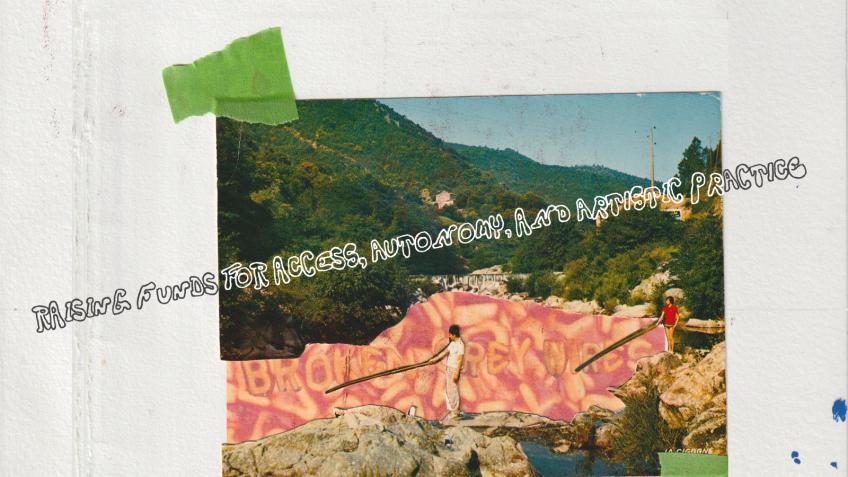
And broken grey wires
In 2016, I founded Broken Grey Wires, an art organisation dedicated to exploring mental illness and disability. Since then, I have curated high-quality, experimental contemporary exhibitions in art spaces across the UK, working with ambitious emerging artists alongside critically acclaimed figures such as Turner Prize winners Martin Creed and Gillian Wearing, as well as Bill Viola, Pipilotti Rist, and cult American icon Daniel Johnston.

📷 Johan Gerz, Gina Birch during PV at The Auxiliary Project Space, Middlesbrough, 2023
📷 Artist Bianco Perry admiring Kirsty Harris's work, with Tim Etchell's neon work behind.
📷 Me, writing out a Before I Die thought for Candy Chang's work at The Williamson Art Gallery, Birkenhead.
With each project, I have built meaningful collaborations with local arts organisations that support communities experiencing hardship, including trauma, addiction, grief, and depression. Working closely with service users, I develop creative workshop programmes shaped through dialogue, co-created through listening and understanding.
The aim for BGW is to develop opportunities for learning, engagement, and self-expression, encouraging participants to explore and better understand their own mental health through creativity.
Lived experience is central to the foundation of BGW, enabling a practice rooted in genuine empathy and connection. I am a queer, disabled woman in recovery, navigating grief following the sudden loss of my father five years ago, and living with bipolar disorder, for which I am medicated. These experiences inform both my perspective and my work.
I strive to be open about my access needs and emotions, including moments of vulnerability. By sharing honestly, I hope to challenge stigma around mental illness, addiction, and disability, and to create space for others in our community to acknowledge their own experiences and seek support with greater understanding and compassion.
Mad Studies provides an important framework for this work, offering a radical perspective on madness and disability by centring the voices of those with lived experience. It prioritises the creation of safer spaces and more responsive support networks within communities.
Building on this thinking, my work actively engages with systems that prioritise transparency and non-hierarchical support. Through BGW, I situate this approach within both historical and contemporary contexts, examining how care frameworks can evolve. Developing models that both support mental health and preserve individual autonomy is still often considered radical. Yet BGW responds to this tension by creating environments that are accessible, ambitious and thoughtfully designed, to invite social, emotional, and cognitive growth.
Why do we do this?
At its core, BGW is committed to building, supporting, and advocating for its community, with marginalised artists in the UK at the centre of all our work. Through our residency programme, we prioritise working with artists who face barriers to engaging in the arts due to disability, race, class, gender, sexuality, mental health, neurodiversity, or care responsibilities.
Evidence continues to highlight the scale of these inequities. The UK Disability Arts Alliance’s 2021 survey of disabled arts practitioners’ points to significant structural barriers and precarious working conditions, while an international study from the same year found that 87% of arts venues and festivals did not include disabled people at all in their programmes or processes. Further research shows that around 60% of artists with mental health challenges feel isolated from mainstream art communities, and Arts Council England reports that 68% of disabled and/or mentally ill artists face significant challenges in accessing creative opportunities.
These figures point to an urgent need for spaces that genuinely support disabled talent, spaces to experiment, to fail, to learn, and to grow. How many artists are struggling, or stepping away from their practice, because the barriers they face prevent them from ever being ‘in the room’?
BGW actively confronts these disparities through the development of an ambitious and experimental residency programme that fosters a supportive, inclusive, and creatively ambitious environment. We are co-designing and building these ‘rooms’ alongside artists who face such barriers, spaces where they can reclaim resources, visibility, and agency. In doing so, the programme not only supports individual practice but also contributes to longer-term systemic change: challenging exclusionary structures, modelling alternative ways of working, and advocating for more equitable conditions across the arts sector. Through this, we aim to generate conversations around art as a catalyst for meaningful social change.
How can you support us! ⭐️
We are currently working in a space in Bootle at SAFE Regeneration, where we are commissioning three marginalised artists offering space, support, mentorship, and opportunity.
The project is called Back Room – ‘two out of three.’ Because the space is quite literally in the back rooms of the building. And from our research we discovered that two out of three artists consider quitting due to the barriers they face.
Over the next 12 months, we will conduct research through creative workshops, focus groups and community collaboration, enabling us to shape a space that offers both artistic and emotional support.
This phase is crucial. It will allow us to gather meaningful feedback and evaluation, helping us to understand what works, and what doesn’t, as we continue to develop a permanent space.
💰 Funds raised will support this research and development phase, enabling us to reach a wider range of community groups and learn directly from people affected by the barriers identified above. We will carry out in-depth evaluation to better understand how systemic barriers impact artists in Merseyside and beyond.
To thank you for your donation and support, we will be creating a Supporters’ Tile Mosaic, where your individual tile will be included. We are excited to develop this as a way to express our gratitude and celebrate our community.
Thank you 💙
Funding method
Keep what you raise – this project will receive all pledges made