
Sarah-Louise Jordan
19th August 2022Mary Wollstonecraft Statue Update
(see pictures of statue after text)
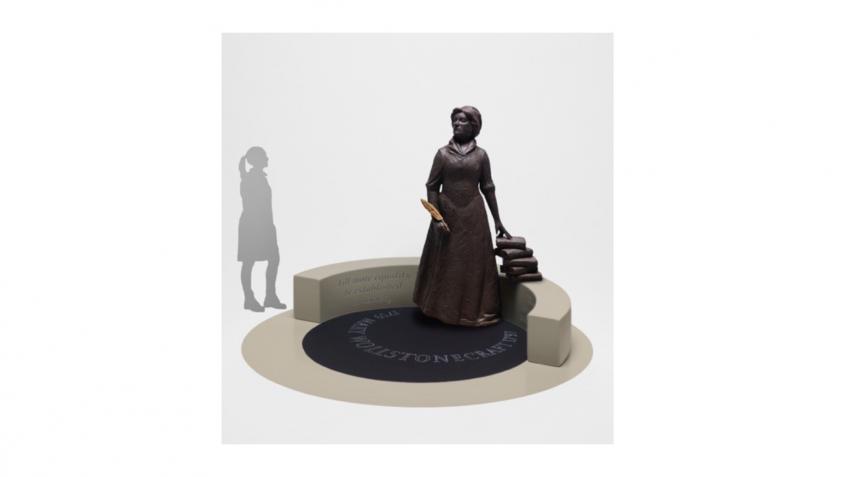
Sarah-Louise Jordan says: "It is such a joy to be able to update you with news of what's happening with the Mary Wollstonecraft statue. As a result of your contributions and patience, she is now many steps along.
It seems fitting that it is such a talented woman, Emma Lavender, who has created this beautiful, moving piece of art. One that commemorates another woman and her work.
Everyone involved in this project will work diligently to make sure the full size statue of her comes into being, as well.
In the meantime, Mary is currently on exhibition and you can see her at Face 2022 https://www.portrait-sculpture.org/open-exibition-face2022 "
Emma Lavender says "I prepared at length for this work. I re-read the Vindication and a few other books to refresh my memory of her writings and thought. I communicated with a knowledgeable and incisive female art historian about previous representations of Wollstonecraft who made a considerable difference to the outcome, as well as many others. I researched the period clothes in detail and Wollstonecraft’s own preferences (she always insisted on wearing a corset whatever the time of day). I looked to the traditions in art history for compositional inspiration. Martin’s competition maquette was the most important thing; it already possessed all elements for a successful public sculpture: strong pyramidal composition; architecture; pose; expression; public amenity.
I have very strong personal/political feelings about the work. But the technical, intellectual and primarily visual rigours of my profession stand paramount. I also believe that the best art comes from sustained dialogue with my peers - both dead and alive – where constant discussions with Martin and other colleagues about this particular sculpture (and sculpture in general) are written all over this work.
The sculpture itself
My main contribution to Martin’s competition maquette was introducing the element of interruption. This theme plays itself out in the sculpture in multiple ways. Why is she standing there?
As a woman, it made sense to me that she had been interrupted from her work – she’d been sitting on the bench writing and reading when the visitor from Porlock appears. I preserved from Martin’s maquette her look of defiance/self-possession, but I also wanted to find a way to create a sense of immanence. This quality had been brought up by a friend about Wollstonecraft. She has risen from the bench, but knows her books have been brushed by her movement, so she is both moving forwards and reaching back simultaneously. Multi-tasking.
She was a writer, so it was essential to keep the quill in her hand for the strong message. Generally, props are bad for sculpture, so one tries to reduce them to a minimum. ‘Costume’ is a prop too - that is the difference between sculpture and Madame Tussaud’s – so although her clothes conform to the period, they aren’t costume. They’re drapery. Drapery has a specific and complex role in figurative art: it is used to create movement, compositional ‘framing’, suggest anatomy, even thought. There has always been abstract art – it’s right there in the two thousand year-old tradition of drapery.
Nonetheless, I stuck her in my own dressing gown (cf Balzac and Hogarth) that meets the style of the period, as writing in the eighteenth century without central heating was a cold profession, and I wanted to distinguish between a portrayal of her really doing her job and the portrayals (all by men) of Wollstonecraft sitting for posh portraits. The dressing gown also contributed to completing the pyramidal composition and solved a problem in the competition maquette where her dress imbalances the quote inscribed on the bench: it meant I could reduce the dress on the tight side and lift the dressing gown end up behind the bench to preserve the pyramid. I wanted to do that because of my belief that her quote – what she actually wrote - should be prioritised compositionally. The complexity of drapery at the back of the sculpture, for me, mirrors her thought.
Good compositional sculpture is incredibly demanding: it must work from all angles – in the round - and pull the viewer to move. The drapery helped with this, as well as uniting the vertical figure with the horizontal architectural axis of the bench – cf. the curved sweep at her front. The whole mass, even in the details, is a rhythm of pyramids. Pyramids focus energy: at the centre of the pyramids is the quill: the act of human agency.
The last major decision I made was to put her in black. This was to honour the more ‘masculine’ portrait made by John Williamson, where it is likely she was dressed this way to make a specific point of asserting her equal worth at the regular dinner debates (largely comprising men) at her publisher’s house. The sculpture becomes increasingly black towards the base.
I decided to make the bench out of bronze for numerous reasons: fewer problems with vandalism and maintenance; continuity of materials between figure and architecture to unite them; above all, so that when people sit on the bench, they will polish the top surface (they will be sitting on knowledge – the bench is made up of stacks of books protruding at its ‘book-ends’), thus bringing the mark of the living to the sculpture.
This is only a brief account of some of my thoughts and decisions on this work. A good sculpture is more than the sum of its parts, but all the same I’ve decided to talk in this way about it because not enough is written by actual makers about what they are doing, how they do it and why. Others will find all manner of things in the work – that’s also the point. To put a work out into the world, it is no longer one’s own. I also want to demonstrate what the end result can be when modelling isn’t subcontracted by the artist (which is increasingly the case), but made by herself (bar the bronze casting process), where every single minute of the making, one is forced into a multitude of decisions. It produces a unified piece of sculpture. It’s simply more honest.
I finished the quarter-scale (50cm) maquette in late January this year after nine months’ work. I gave it my all. Next, Pangolin Editions fine art foundry in Stroud digitally fabricated and printed the bench, inscriptions and hard landscaping. I submitted this maquette to the annual international competition of the Society of Portrait Sculptors in March and it will be exhibited at Face 2022 at the Garrison Chapel in Chelsea this August. Please see Sarah-Louise Jordan’s post for details.
Thank you to all those who contributed to this project on Crowdfunder; thank you to so many others; thank you to Martin. My greatest thanks are to the inspirational Sarah-Louise Jordan who set up the Crowdfunder and got the ball rolling. Without her, this sculpture never would have happened.
I feel this project has embodied the best of bringing people together; solidarity, a core principle of the Feminist Movement, has been the driving force of how we have got to where we are now. It pays best tribute to Wollstonecraft herself. For this reason, some people are worth commemorating publicly, not for idol worship (we all have our faults), but because they actively challenge us to widen the scope of our imaginations of what is possible in the world beyond our own limits. For women everywhere, this need is as urgent as ever."