St Just Parish Church - Raise the Roof! Appeal
St. Just, England, United Kingdom
Aim
We need to raise £50,000 to secure grants for a new church roof of 6 slopes and 15,000 slates
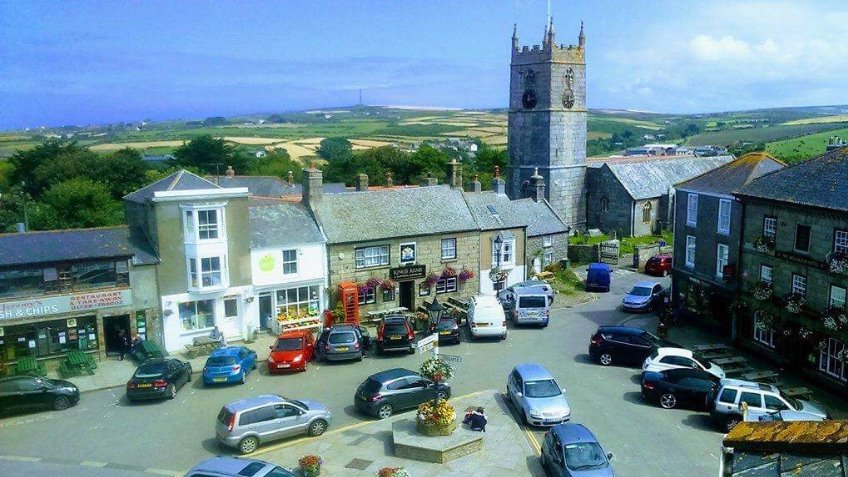
Our ancient, grade II listed church is a fine building located at the very heart of the town of St Just-in-Penwith, the most westerly town on the mainland of Britain, about seven miles west of Penzance, Cornwall. Our parish forms part of the gloriously wild and ruggedly beautiful area of West Penwith at the most westerly tip of Cornwall. The parish and town have been shaped by its industrial mining past and is part of the UNESCO Cornish Mining World Heritage Site as well as being in the Cornwall Area of Outstanding Natural Beauty.
Our present church is medieval in origin. It houses the Selus Stone which is thought to date from the late 5th or early 6th centuries.
We are planning to replace the whole of the Church’s six sided slate but very, very leaky roof – at once! This is a huge undertaking but is needed to secure, protect, and insulate the building for use by future generations.
Our Church is at the heart of the Town's life serving those nearby and the largely rural community around and so we want to help the residents of the Town and Parish of St Just-in-Penwith to further engage with and enjoy their historic legacy which is the Parish Church. So we are also aiming to completely replace the Church’s dilapidated heating system and remodel part of the west end of the Church to make for a more community friendly space, along with facilities.
The funds raised through this Appeal will be directly spent on the replacement of the Church's roof.
LOCATED IN the westernmost of the nine ancient hundreds of Cornwall, St. Just-in-Penwith or Lanuste, ‘Church-site of St. Just’ has been described as being ‘set in a granite and greenstone country of windswept treeless farm tenements and black, carn crowned moors’. Founded by Saint Just, one of the sons of a 5th century Cornish King Gerient I, St Just-in-Penwith Parish Church (TR19 7HA) has seen Christian worship for over fifteen hundred years, providing the religious focus for the small farms, mining and fishing communities in the parish. Our parish forms part of the gloriously wild and ruggedly beautiful area of rural West Penwith at the most westerly tip of Cornwall. The parish and town have been shaped by its industrial mining past and is part of the UNESCO Cornish Mining World Heritage Site as well as being in the Cornwall Area of Outstanding Natural Beauty. Our Church has a very rich history and the earliest written record thought to exist of the Church dates to 1254 when the value of the benefice was assessed as £8.

The church is run by the Parochial Church Council whose principle functions are defined by the Parochial Church Council (Powers) Measure 1956 as “promoting in the parish the whole mission of the Church, pastoral, evangelistic, social and ecumenical”.
The project for which the Parochial Church Council is currently seeking funding is a new roof for its church building. The large 6 sided Cornish slate roof was last replaced in 1866. The project will involve the following:
The present church is medieval in origin and built in the classic Cornish pattern church of three aisles and a tall west tower. The ancient church was rebuilt in 1334 as a Cruciform Church and rededicated on 13 July 1336. Sadly only part of the chancel remains from the church built in 1334. This cruciform church itself was re-modelled in the early C.15th creating the outer aisles and tower. A C.19th restoration created the current roof in 1866 when the original waggon style roof was replaced with new Deal timbers and Cornish slates. The external façade is of granite ashlar. Over the doorway to the porch is a fine C.18th slate sundial. It is inscribed with the name Nicholas Reseigh and the legend or motto in Latin ‘Sic transit gloria mundi’ or ‘Thus passes the glory of the world’. Today’s churchyard is thought to be the site of an early religious enclosure or Lan. The Cornish name for St Just being Lan Uste. Key internal features of significant historical interest within the Church building include:
- Selus Stone: An inscribed 5th or 6th Century memorial stone with Chi-Rho Monogram - one of earliest early Christian memorial stones. The stone is thought to refer to Saint Selevan a brother of Saint Just and was found built into the wall of Chancel in 1834.
- Inscribed stone – apparently a former saddle quern also possibly from the 5th or 6th Century recently moved from the old vicarage.
- Memorial Cross Shaft: 8th – 10th century decorated in the Celtic style – interlacing, found during the restoration of 1865-66 and as north aisle building block.
- Flamboyant east window tracery for east window of aisles like Padstow – late 14th or early 15th century date.
- Piers, pillars and capitals: Of limestone possibly Beer or Caen stone, exceptionally well carved and unusual for Cornish and remote rural churches. Shields on capitals: de Beaupré, Bray and Fitz Ive families and monograms for ‘M’ and ‘J’.
- Religious label stops for south aisle windows including fleur de lys, G or J for Jesus and a buckle-like M for the Virgin Mary. The same devices appear on shields borne by angels on south aisle capitals.
- Secco Wall Paintings: Pre Reformation / 15th Century ‘Christ of the Trades’ and ‘Saint George and the Dragon’, found during the restoration of 1865-66.
- Reredos: Beautifully carved of Derbyshire Alabaster from 1896, depicting 14 Cornish Saints in alcoves. Centre left hand panel shows a representation of ‘The Adoration of the Magi’ and the right hand panel represents ‘The Annunciation’.
- Ensign of HMS Revenge: Flown at the Battle of Jutland in 1915 during World War I. Wrapped around the drumhead altar at the commemoration service at Lyness Cemetery on the island of Hoy, Shetland in 2016.
- St Just’s original World War Memorial Window – to those who died in the Great War. Unusual as it has the image of a ‘Private’ solider on it - when most war memorials of that time depict Commissioned Officers.
- Internal Pointing - Highly unusual Cornish random rubble type of construction, accentuated by the pitch lining and black pointing of the natural granite. Trademark black mortar used by J.P. St. Aubyn for Victorian restoration.
Outside the Church and tower are of granite ashlar and the churchyard also contains the ancient Market and Grous Crosses and a number of Granite Ashlar tombs. A Plain an Gwary or open air playing place lies across the main square.
Unfortunately, the Church building is now listed on the Historic England’s Heritage At Risk Register Category C noting that “the slate roofs are failing and have caused the fall of ceiling plaster. Rainwater goods are rusted and failing”. A Faculty will be granted shortly granting permission for the roof replacement work to be carried.
With the decline on farming, fishing and tin mining over the last recent decades St Just has suffered economically and socially. However, today there is a very real enthusiasm within the Town to both promote and share the history and preserve this heritage for future generations. The Town ‘s economy is being revitalised by more opportiunitires for visiting throughout the year supported by a new artistic community – from local and afar and the Town’ role in the former mining industry is a key part of the National Trust’s Tin Coast Project which should support the Town’s economy and sustain visitor numbers throughout the year.
This project successfully funded on 27th June 2018