Always on
This project successfully funded on 24th March 2026, you can still support them with a donation.
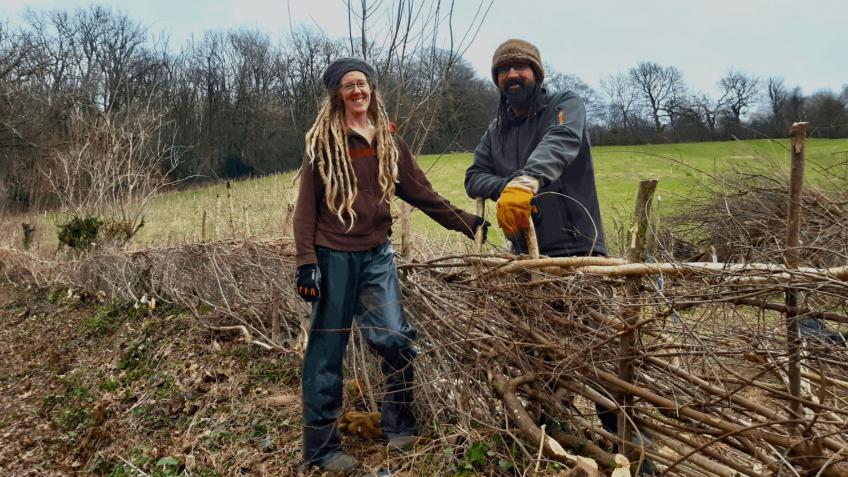
This project successfully funded on 24th March 2026, you can still support them with a donation.
To fund habitat creation, restoring living pasture, where trees, grazing animals, water, wildlife and people work together again.
**Due to technical issues with crowdfunder, to view in full on a mobile phone, please turn to landscape.**
Bringing Trees Back Into Grazing Land at Coed Glas
At Coed Glas, in Carmarthenshire, we are restoring a piece of land into a living, resilient system, one that feeds people, supports wildlife, slows water, builds healthy soils, draws down carbon and restores biodiversity.
With your support, we are ready to take the next step in that journey:
bringing trees back into the pastures.
This approach, known as silvopasture, weaves trees, grazing animals, water and soil life into one connected system. It recreates many of the benefits of traditional wood pasture, a rich and complex habitat once widespread across the UK, while responding to the realities farming faces today.
Your support will help us begin transforming a field that has been simplified for decades, into something far richer, a landscape that can adapt, endure and nourish life for generations to come.
What your support will fund
Your contributions will directly support:
The total target for this crowdfunder reflects the full cost of establishing each silvopasture row properly, ensuring canopy trees are supported by surrounding pioneer and fodder species with protection, soil preparation and water management in place. Details of costing can be found below.
With your help, we can transform this field into a living mosaic of grasses, wildflowers, trees, water, animals, fungi, invertebrates and birds.

Why farming like this matters right now
Farming is under growing pressure.
Extreme weather is becoming more common. Soils are losing life. Wildlife is declining rapidly. Many farms are being pushed towards systems that rely on high inputs, fragile supply chains and ever tighter margins.
Bringing trees back into grazing land is one of the most effective ways to respond to these challenges, trees:
This isn’t experimental or new. It’s a return to ways of farming that work with nature, updated for the world we’re now living in. We hope that this crowdfunder can help us make this possible.
A living landscape and a missing piece
Coed Glas already supports a diversity of habitats, shaped by water, soils and careful management.
We are the guardians of around six acres of secondary woodland, including areas of wet woodland dominated by alder and willow with a hazel understory and oak, birch, rowan and beech scattered throughout. Below this lies a three acre wet meadow supporting one of the largest known stands of wood horsetail in Carmarthenshire, alongside four orchid species and many other native plants. Over the past three years we have been recovering this meadow from the encroaching bramble, helping to protect this vulnerable habitat.
A steep, wooded ephemeral stream runs through the centre of the land. Here, we have been installing simple, nature-based structures to slow water, increase infiltration and create new wet habitats.
Across the remaining grassland, around 11 acres of previously high-nutrient, species-poor pasture, we are rebuilding diversity. Through low-input grazing, traditional land management and patience, we are creating the conditions needed for species-rich grassland to once again flourish.
To the north of a small timber barn we have recently constructed, new hedge banks are beginning to establish, while the new ponds, scrapes and willow beds are already coming alive with invertebrates, birds and amphibians. Nearby, our expanding annual horticulture plot sits alongside a developing multi-layered food forest. Elsewhere on the land, we have planted native trees to form rotational coppice, shelterbelts, wildlife corridors and have restored the roadside boundary through traditional hedge-laying.
What’s missing, and what this crowdfunder will hopefully help us achieve, is trees within the pasture itself allowing grasslands, livestock, water and woodland to function as a single, resilient system.
Trees that work together
The silvopasture rows will be diverse by design, with each species chosen for the role it plays in the wider system.
Alongside productive nut and fruit trees, including walnut, heartnut, pecan, sweet chestnut and carefully chosen fruit varieties, we will plant a wide range of pioneer and support species, including:
These faster-growing pioneers prepare the ground for slower, longer-lived trees. They create shelter, condition the soil and help establish the rhizosphere and mycorrhizal fungal networks that allow plants to share water, nutrients and trace minerals.
This living underground network is especially important to support resilient establishment and improve access to micronutrients.
For more information on Silvopasture:
https://www.woodlandtrust.org.uk/plant-trees/agroforestry-benefits/silvopasture-alleys/
Pasture brought back into relationship with trees and water
We hope to establish rows of trees across our west-facing fields, designed not just for food and fodder, but for habitat creation, water management and long-term resilience.
Running down the centre of this field is a naturally wetter band, where surface water flows during and after heavy rainfall. Rather than draining this water away, each tree row will cross this wet strip, turning a challenge into an opportunity.
At each crossing point, we plan to:
This approach, already used successfully elsewhere on the land, helps water stay in the landscape. Rain infiltrates slowly, soil moisture is recharged and young trees are better supported through dry periods.
Small wet places with big impacts
These shallow scrapes and damp margins create ephemeral wet habitats, wet in winter and after rain but often drying back in summer. Though easily overlooked, these habitats are among the most valuable in farmed landscapes.
They can support:
Willows are especially important, supporting hundreds of invertebrate species and providing nectar and pollen when little else is in flower.
By allowing tree roots to access these damp zones, we help establish stronger trees, while the trees shade soil, reduce evaporation and stabilise wet ground. Over time, leaf fall, roots and fungi build organic matter, locking carbon into rich living soils.
A closed-loop grazing system
The Silvopasture will support our wider low-input livestock system.
We keep cattle in low numbers, outwinter where conditions allow, make our own hay and compost manure which is returned to the land. In time, we hope to introduce sheep to graze after cattle, improving sward structure, reducing parasite pressure and helping diversify the pasture beneath the trees.
Shelter, tree fodder and healthier soils increase wellbeing and reduce reliance on external inputs, keeping the system grounded in what the land itself can provide.
Habitat above and below ground
This project is as much about wildlife recovery as it is about farming.
Silvopasture creates a layered landscape, from soil fungi and roots, through grasses and wildflowers, up into shrubs and tree canopies. Each layer supports life in a different way.
Trees that feed whole food webs:
Together, these species provide food and shelter year-round.
Life beneath the trees: grassland becoming meadow
Through reduced inputs and varied grazing we aim to diversify the pasture into species-rich grassland over time. The UK has lost over 98% of its species-rich grassland and wildflower meadows in less than a century, making these habitats among the rarest remaining in Great Britain.
This habitat supports:
Dappled shade creates a mosaic of conditions, allowing greater diversity than open pasture alone.
Carbon stored through living systems
Silvopasture is one of the best stores of carbon, not just in tree trunks but through biology above and below ground.
Leaf fall feeds fungi and invertebrates. Roots release sugars that stabilise soil carbon. Diverse litter builds long-term organic matter. Healthy soils support healthy plants, which support invertebrates, birds and grazing animals.
Growing something to share
This project isn’t just about what happens within our own boundaries.
It’s about what this land can offer beyond them.
At a time when many people feel disconnected from food, land and nature, and when farming itself is under enormous pressure, we believe it’s important that places like this exist, places that show different ways of working, rooted in ecology, care and long-term thinking.
As Coed Glas continues to develop, we hope it can stand as a living example of resilient, low-input farming. Not as a finished model or a blueprint but as a real, evolving landscape that shows what’s possible.
Over time, as the system establishes, we hope the land can be a place where others feel inspired, where practical skills and experiences are shared, and where people can reconnect with the sources of their food and the landscapes that sustain them. A place that sparks ideas, conversations and confidence to try something different elsewhere.
Landscapes that are rich in life, shelter and diversity don’t just support wildlife, they support people too. Time among trees, water and animals has real value for health and wellbeing, offering space to slow down, reconnect and feel part of something living.
By supporting this project, you’re helping to grow not just trees but confidence in a different way of doing things. Regardless of whether you are able to make a donation or not, we would welcome anyone interested in knowing more about this project, or anyone keen to visit or volunteer to please get in touch via email.
[email protected]
What your support will fund
Our costings are based on:
If we don’t reach the full target, every pound raised will still go directly into planting, prioritising canopy trees and the surrounding fodder and support species needed to give each one the best chance of long-term success.
If we exceed our target, any additional funds will be used to expand habitat creation, extending wet features, increasing tree diversity and strengthening the ecological function of the system as a whole.
Every donation will help turn simplified pasture into a resilient, wildlife-rich system that will function for generations.
Join us in growing something that lasts
This is slow, careful work. Trees take time. Systems take time.
But with your help, we can transform this field into a living mosaic of grasses, wildflowers, trees, water, animals, fungi, invertebrates and birds.
By supporting this crowdfunder, you’re not just helping to plant trees.
You’re helping to restore relationships between land and water, farming and wildlife, people and place.
Thank you for being part of that story,
Dana, Stu, Thoren & Asher.
Funding method
Keep what you raise – this project will receive all pledges made