
Communities Fund provided £50 of match funding
Your donation unlocks match funding
Boost your impact
Your donation unlocks match funding
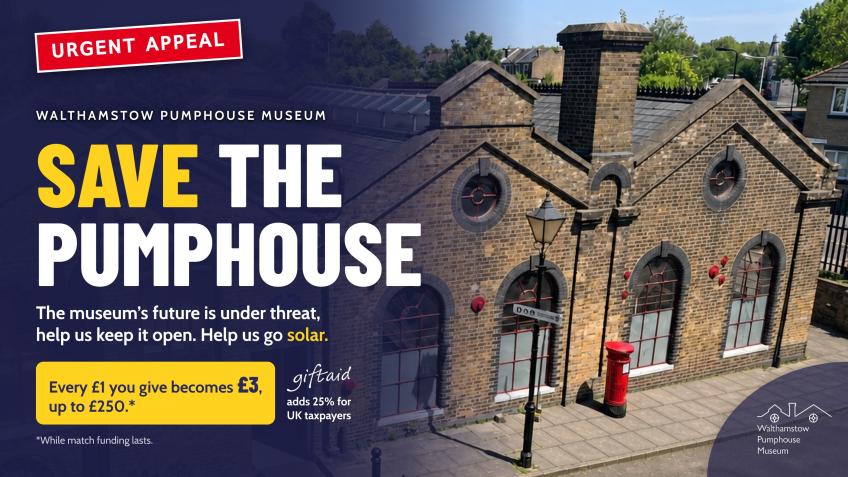
The museum's future is under threat, help us keep it open. From Christmas we face a £40,800 a year electricity bill. Help us go solar.
Walthamstow Pumphouse Museum is a free, volunteer-run museum in a Grade II listed Victorian pumping station that helped make north-east London a healthier place to live. Around 17,000 people visit us every year.
Free Sunday open days, with our Marshall steam engines brought to life by volunteers
Free craft activities for children and families
School and group visits, including young people and special needs schools
Work experience placements and university projects
The Tool House, our community workshop, where local people learn practical making and mending skills
Volunteer work days, caring for our collections of fire engines, transport and local industry

Preventing: new insulated roofs, 60 solar panels, a battery and more heat pumps will save an estimated 49,000 units of electricity and avoid an estimated 6 tonnes of CO2 a year, with clean power made and used here in Walthamstow. As we add panels to our other roofs, spare power on quiet days will go into the local grid.
Preparing: replacing uninsulated asbestos roofs and old electric heaters makes our Victorian buildings more resilient. Insulation and heat pumps keep them more stable through heatwaves and cold snaps, protecting the collections and keeping the museum comfortable for visitors and volunteers. Our volunteers, including young people, gain practical skills in solar, insulation and energy saving.
Adapting: through The Tool House, local people learn to repair, reuse and upcycle rather than throw away, keeping furniture, electricals and plastics out of landfill. And as a former sewage pumping station, we plan to help schools and visitors understand waste, what goes down the drain and how to keep our local rivers clean.
The Tool House, our community workshop on the museum site, helps local people repair and reuse rather than throw away. So far this year, 259 places have been booked across 30 workshops.
Upholstery classes help people bring their own furniture back to life instead of sending it to landfill
Furniture upcycling and repair gives pre-loved wooden furniture a new lease of life. Around 30 pieces have gone to our local Salvation Army this year
Plastics reuse and recycling with Sean Rodrigo of the Fixatorium recycles waste plastic, including bottle caps collected from local cafés and bakeries
Repair classes, including free sessions for local residents sometimes funded by Waltham Forest Council, help people fix simple faults and keep their electricals out of landfill
DIY and plumbing for beginners give people the skills to look after their own homes
Repair cafés: we have hosted Forest Fixers, a local repair café, where volunteer fixers mend small electricals such as toasters, lamps and radios
The Pumphouse was built as a Victorian sewage pumping station, part of the work that made north-east London a healthier place to live. Dealing responsibly with waste is part of our story. Once this project is in place, we plan to run sessions for schools and visitors on waste, what goes down the drain and keeping our local rivers clean.
Until now, the museum's electricity has come through Waltham Forest Council's supply at no cost to us. That arrangement is ending. By Christmas we are due to be on our own metered supply, and for the first time we will pay for every unit we use.
We've measured our use hour by hour for a full year. At business prices it comes to about £40,800 a year, around £6,700 in January alone, and one and a half times our best year's surplus. A single winter could use most of our reserves. Without action, the museum's future is at serious risk.
We’ve asked Waltham Forest Council for two things: to keep our current supply connected for two more years while we make the switch, and a one-off £50,000 to replace two asbestos roofs with insulated ones and fit solar panels and a battery, installed by our own volunteers to keep costs down. We’re still waiting to hear back, and we can’t count on a yes, and the bills could start this winter.
So we're asking you.
Smarter heating controls, already going in
More heat pumps, adding to the two we've already installed
Insulated roofs in place of our old asbestos ones
Solar panels and a battery, so we make our own power
Together we expect these to cut our bill from £40,800 to about £19,000 a year. With further funding, that's a gap we can close ourselves.
Our target is £50,000. It will go towards three things that work together:
New insulated roofs on the old fire station and workshop, replacing the uninsulated asbestos sheets so less heat escapes
60 solar panels and a battery on the new roofs, which we estimate will make about 22,000 units of clean electricity a year
More air-to-air heat pumps to replace our remaining direct electric heaters. Heat pumps give about three units of heat for every unit of electricity, so they can keep our historic buildings and collections warm and dry using far less power
Together we expect these to save around 49,000 units of electricity and £12,800 a year, avoiding an estimated 6 tonnes of CO2 a year. As we add panels to our other roofs in future, spare power on quiet days will go into the local grid, cutting carbon in Walthamstow too.
What each stage pays for:
£23,000: the asbestos off the old fire station, a new insulated roof, our first 20 solar panels and a battery to store sunshine for the evening
£25,000: 20 more panels on the other side of the fire station roof
£41,000: a new insulated roof and 20 panels on the workshop too, completing our 60-panel scheme
£50,000: more heat pumps to replace our remaining electric heaters
Your gift goes further: two of our supporters have offered to match donations.
Match funding won’t last long. The Aviva Communities Fund only matches donations made in the six weeks after we launch, up to £25,000 in total, and only your first donation (up to £250) is matched. Please give early and share our page, so we can make the most of it.
Thank you to the Aviva Communities Fund and to our private donor for backing the Pumphouse.
Our volunteers, including qualified electricians, will fit the roofs and solar panels, and the old asbestos sheets will be collected and disposed of by a licensed asbestos waste contractor. Once the money is raised, we expect the work to take four to five months.
£27 pays for 100 units of electricity we'll never need to buy
£77 sponsors a solar panel
£3,000 safely removes the asbestos roof
£3,500 buys the battery
Carbon estimates use the UK Government's 2026 greenhouse gas conversion factor for grid electricity.
A live display in the museum showing what the panels produce, and regular updates as our volunteers lift the old roof and fit the new one.
This museum was built to keep London healthy. Please help us keep it going.
Communities Fund provided £50 of match funding
Funding method
Keep what you raise – this project will receive all pledges made by 9th February 2027 at 5:40pm