Always on
This project successfully funded on 19th August 2026, you can still support them with a donation.
This project successfully funded on 19th August 2026, you can still support them with a donation.
We are raising money to cover the cost of preparing a portion of a gigantic pliosaur jaw so that it can be researched and published upon.
What are pliosaurs?
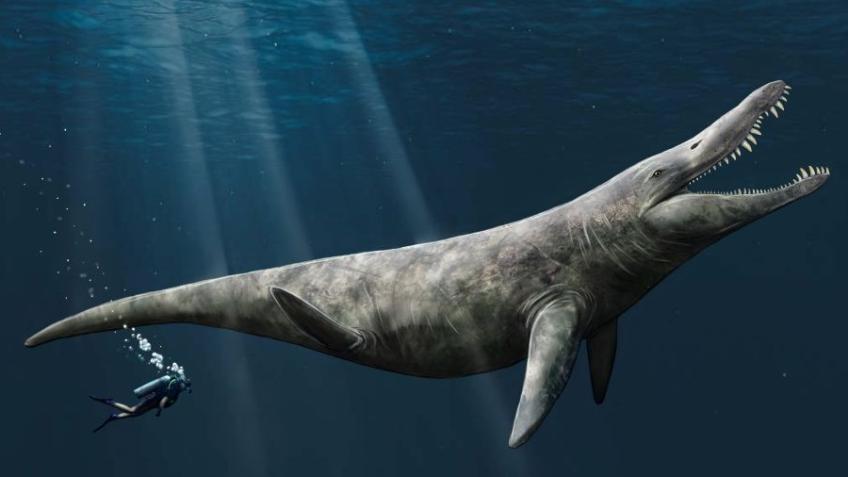
Pliosaurs are a group of marine reptiles that existed from the Jurassic to the Cretaceous - a range of over 110 million years. They had a unique body plan with massive heads, short, stocky necks, a barrel-shaped body with a short, tapered tail and four large flippers. Some species were apex predators and evolved gigantic fang-like teeth and body sizes perhaps as much as ~12 m long!

Pliosaur skeleton by Hamzah Imran
The beginnings of a mystery
In the collections of the Falmouth campus of the University of Exeter, there is an enigmatic fossil with no identification and no provenance. It is noteworthy for the size of its conical teeth and the massive sockets they sit in. The specimen was collected between 1967-1990 as it was originally housed in the geology department of the university’s Stretham campus, before being moved to Falmouth. It was not until last year that the importance of the fossil was realised. Ms. Rosie Ward, an undergraduate student and Dr. Stephen Hesselbo of the University of Exeter identified the fragmentary fossil as part of a pliosaur mandibular symphysis, the tip of the jaw where the two halves join. Coincidentally, myself and my supervisor Dr. Judyth Sassoon of the University of Bristol happened to be researching Jurassic pliosaurs from the UK. We were contacted by Rosie and Steve and invited to examine the specimen. We immediately recognised the unique nature of this fossil and began this collaboration. But a fossil with no provenance data is of little scientific value without its locality and geological context. Thus began a mystery that required solving.
Dorsal view
Ventral view
What makes this fossil so special?
Despite only having the tip of the jaw, the fossil is utterly remarkable for its size. The largest tooth sockets are over 5 cm in diameter, which is comparable to some of the largest pliosaur jaws and teeth ever discovered. While we cannot make any precise estimates on body size yet, it is clearly one of the largest pliosaurs ever, and depending on its age, it may be one of the first of these giants of the Jurassic. The fossil preserves many important features that, when prepared, will help us identify to which species it belongs to, or if it is something new. These include the shape and length of the symphysis and the features of the teeth.
Comparison to another large pliosaur symphysis
Lateral view of the gigantic tooth sockets, replacement teeth can be seen
Close-up of a tooth
What we are doing to identify the locality and precise age
We are reaching out to any geological parties who might recall such a specimen being discovered on a field trip to one of the great Jurassic Clay formations, especially the Oxford Clay and Kimmeridge Clay formations. So far, we have drawn a blank, but our money is on it coming from the Oxford Clay, perhaps of the Peterborough district.
We are performing nano-fossil and ammonite biostratigraphic techniques that are proving helpful, but the results at present do not coincide. We are also attempting radiometric dating, but this is wholly dependent on there being sufficient uranium trapped in the calcite that lies within the bones.
Why are we crowdfunding?
The fossil is embedded in a very hard rock matrix that obscures many of the important features we need to examine in order to identify this animal. Without this important information it will be very difficult to confidently identify the specimen and calculate its original size. We are raising money to fund the preparation as this is a labour intensive, and highly skilled task, mostly due to the significant hardness of the rock. We have been quoted a figure by an expert preparator with many years of experience and has featured on many dinosaur documentaries with Sir David Attenborough.
The outcomes
After preparation, we will scan the surface of the fossil so we can study it digitally (it is very heavy to study as a ‘hand’ specimen!). We will be able to describe the jaw and its teeth and thus identify its species, along with calculating its body size. The end goal is to publish a paper on this enigmatic but exciting fossil and put it on display in a public museum.
Who am I?
I am Eddie Bartlett - a PhD research student studying Jurassic pliosaurs at the University of Portsmouth under the supervision of Dr. Roy Smith (University of Portsmouth) and Dr. Judyth Sassoon (University of Bristol).
Funding method
Keep what you raise – this project will receive all pledges made