Open the Gates Legal Fund
Burntisland, Fife, United Kingdom
Aim
To take legal advice to support the case that the public have enforceable rights of access to Burntisland harbour.
It’s oor Harbour!
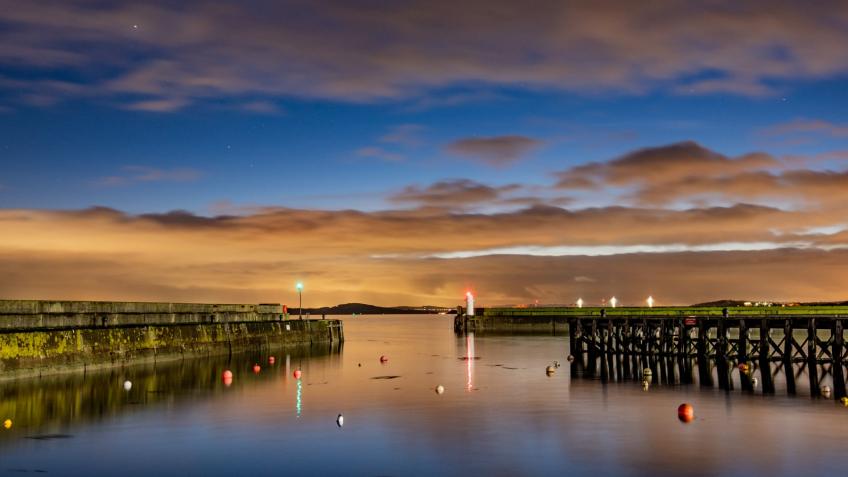
Burntisland has always had a harbour, the larger part of which has always been accessible to all. Whilst the commercial importance of the harbour has declined significantly, its importance as a well-loved, well-used community asset, has not. Last year, despite the harbour being at its lowest ebb in living memory, Forth Ports decided to fence off the East Dock, preventing all waterside access.
Bang to rights!
Although enterprising locals have "adapted" the fence to allow passage through, we have to be realistic and accept that sooner or later it will probably be reinforced to resist all attempts to breach it! Do we have a legal case to insist on public access? We think so, and we’ve spent a lot of time researching this. In our favour we have identified:
Legally enforceable ‘title burdens’ applying to various parts of the harbour, which place contractual obligations on Forth Ports to provide open community access.
Various Harbour Acts requiring open access to parts of the harbour
Forth Ports have also acknowledged that customary rights of access for fisherman exist over Shank’s Pier (also known as the Dead Boats / Western Peninsular), although this hasn’t stopped them fencing it off.
The more recent Right to Roam legislation may also provide some further rights.
So why can’t we simply demand that public access be reinstated?
The problem here lies in the role of Forth Ports as the Harbour Authority, a status which provides them with the ability to create bylaws. So, whilst there is no doubt, for example, that Forth Ports are required to provide open public access by the existing ‘title burdens’, and potentially by the Harbour Acts, what we don’t know is whether these requirements can be nullified by bylaws? The earlier Harbour Authority, before privatisation, for example, did pass bylaws restricting access but these were never enforced.
Unfortunately, these are not simple questions, and to get to the bottom of this we now need specialist legal advice. We have put all our findings together in a legal brief and put this out to tender with six specialist legal firms. One of these, BTO, has now been selected as the favoured adviser. We cannot, of course, be certain, but BTO does consider that we could well have a case, based upon what we have found. We now need to go ahead and give them formal instructions to investigate this very complex legal matter and then act accordingly.
Update 22nd August 2023:
WOW!! £4208 has been raised for the Open the Gates Legal Fund, £1732 through the Crowdfunder and the remainder by direct donation from the Big Green Market, Burntisland Acoustic Music Club and individual supporters. Thank you all!
We were at the lawyers yesterday, and we’re delighted to advise that the Barack Room Lawyer was right! Over the next four weeks the Legal Eagles will review and report and we’ll share their findings with you.
And then what? Well, most likely, the lawyers will present a compelling case demanding Forth Ports abide by their legal responsibilities over access. If they decline we may need a King’s Counsel’s opinion - basically the professional opinion of a judge. If Forth Ports still decline, we may need to go to court to enforce our rights. Hopefully it won’t come to that, but rest assured BHAT won’t give up, the law's on our side!
We still need £300 to reach our immediate fundraising total and with one last push from supporters we’re hopeful we’ll make it. Please do share this post and if you can maybe make a wee donation.
Onwards and Upwards! We’ll get there yet 
Update 12th August 2023:
Our fund-raising campaign is going really well but there's still a long way to go! Being the beneficiaries of last weekend's Big Green Market gave our fund a massive boost, to add to the proceeds of the tombola and donations at the Market, all the generous donations of our supporters and further amounts raised at the acoustic music club. Look out for news about an exciting fund-raising concert coming up in the autumn! Thank you for your continued support.
Alan Hobbett delivers the third of his briefings:
A wurd in yir ear ………………… BHAT Barrack Room Lawyer Briefing no 3
This is the third in a series of briefings from our very own Barrack Room Lawyer, entirely untutored and unqualified in law, but he did once read a book on customary law, so until we raise the money that we need to take specialist legal advice, it’s the best we can do (but do bear in mind these arguments have been discussed with genuine lawyers who feel we may well have a case!).
Statutory Rights (and a wee bit on rights acquired by prescription)
Did you know that ‘statutory law’ is law that’s created by statute i.e. an act of parliament?
“I guess the clue’s in the name!” Yes, thank you Oscar Wilde. The point though is that unlike rights under customary law, or obligations arising from contract, these rights apply to us all. As far as laws go, statutory law is at the top of the legal tree.
“Tell me more.“ Well, until the Land Reform Act 2003, rights of access were covered by many different laws, including customary law, rights created through contract, common law rights by prescription etc, but from 2003, there has been a basic right to roam.
“So, I can walk wherever I like then, regardless of what anyone else says!” Well not quite, the right to roam is a right of responsible pedestrian access across land, it means you have to be responsible in exercising that right, and you have to be considerate of other people and their property. There are certain restrictions though, you couldn’t just walk across your neighbour’s garden uninvited, for example.
“Have you met my neighbour?!” No, but my point here is that whilst there is a general right to roam, it is limited. As a basic rule of thumb, if you think you are walking too close to someone’s kitchen window, you probably are.
“And what aboot the harbour?” Well, this is where it gets tricky. Initially we were repeatedly advised that the right to roam didn’t apply to the harbour, in the same way, for example, that it doesn’t apply over railway lines or airfields etc. However, we were also told, by the same advisers, that the harbour was excluded from the community right to buy, which we subsequently demonstrated wasn’t the case. Anyhow, having spent a long time looking at this, and taken further specialist advice, we believe that there could indeed be areas of the harbour covered by the right to roam.
“Well, that’s encouraging!” Yes, we think so. There are also a few other areas of statute law that are also important.
“I’m all ears.” Well, as you’ll know, public rights of way have been about for a long time, covered by much older laws, amended, most recently, by the Prescription and Limitation (Scotland) Act 1973. This says that a public right of way exists by ‘prescription’ wherever a route:
- joins two public places (e.g. public roads or other rights of way); and
- follows a more or less defined route; and
- has been used, openly and peaceably, by the general public, as a matter of right, i.e. not just with the permission of the landowner; and
- has been used without substantial interruption for at least 20 years
“Like me walking from the Lammerlaws to the train station to catch my train to work?” Exactly so. In fact, we think this is why Forth Ports amended their original application for listed building consent for the fence, to allow a through-route to the station from Lammerlaws Road, as we’re pretty sure they realised that a public right of way had been created. We also think, that the breakwater and the outer harbour should also rightly be considered public places, in the same way the Court recognised Cove Harbour, as a public place, as mentioned in the last briefing. This would mean that routes to them are also public rights of way.
“Let’s get doon there then! Hey Ina, where’s ma’ grinder?” Hang on Citizen, we can’t be sure yet, we need further advice.
“Hmmn, interesting. Would it help if I bunged you another few quid and encouraged my neebors to do the same?” Absolutely it would. Thank you.
And please bear in mind this is just the third area of legal argument we think acts in our favour. Our Barrack Room lawyer has briefed on two others already…… Do help if you can.
Update 3rd August 2023:
Alan Hobbett delivers the second of his briefings:
A wurd in yir ear ………………… BHAT Barrack Room Lawyer Briefing no 2
This is the second in a series of briefings from our very own Barrack Room Lawyer, entirely untutored and unqualified in law, but he did once read a book on customary law, so until we raise the money that we need to take specialist legal advice, it’s the best we can do (but do bear in mind these arguments have been discussed with genuine lawyers who feel we may well have a case!).
Customary Rights
Did you know that all systems of law originally developed from local customs?
“Like not parking your car on a zebra crossing?” I’ll ignore that. What I mean is that before we had formal written laws passed by rulers or parliaments, we all lived according to local customs, customs that had gradually evolved over time to become, in effect, the law.
“Aye mibbe, but that was a long time ago.“ True, but ‘custom’ remains one of the four recognised sources of law, even today.
“Interesting. So, give me an example?” Well, there’s a fairly recent case which went to the High Court, from Cove in Aberdeenshire.
“I’m all ears” For generations local fishermen had used Cove Harbour, despite thet fact that the harbour, and the road to it, was in private ownership. The old landowner then sold the harbour, and the land about it, to another. The new owner decided he didn’t want people to use his harbour, so he told the fishermen to move all their gear, and then blocked the road with boulders and piles of gravel.
“A bit tight that!” I’m sure he had his reasons, but the point about this is that the local fishermen went to court arguing that they had customary rights of use over the harbour and a right of access over the road. The judge ruled in the fishermen's favour, stating that despite the fact the harbour was privately owned, it was clearly a ‘public’ place, with a very long history of local use. He also noted that the continual use of the road to access the harbour, by foot and by vehicle, meant that a public right of access (pedestrian and vehicular) had been created.
“And the outcome?” Well, it didn’t all go the fishermen's way, they weren’t allowed to store their boats on the land anymore, but the Court ordered that the boulders should be removed and that public access must be reinstated to the harbour.
“This is all sounding a wee bit familiar. I ken a harbour that was blocked off, having previously been accessible to all, for as long as anyone can remember.” So do I. In fact, having looked a bit more closely at this case, we believe, and what’s more Forth Ports have elsewhere stated, that customary rights over Shank’s Pier (variously called the Dead Boats or the Western Peninsular) do indeed exist.
“Yet, they’ve fenced it off?” I know. What’s more we also think that customary rights of access may also exist over the breakwater and the outer harbour area.
“Let’s get down there then! Hey Ina, where’s ma’ grinder?” Hang on Citizen, we can’t be sure yet. Although we believe customary rights of access do exist, that doesn’t mean ‘we’ can necessarily force Forth Ports to open the gates.
“So we just have tae lump it?” We don’t think so. We think that we could potentially get the customary rights of access enforced, but unless we have specialist legal advice, we’ll never get Forth Ports to relent.
“Hmmn, interesting. Would it help if I bunged you another few quid and encouraged my friends and neighbours to do the same?” Absolutely it would. Thank you.
And bear in mind this is just the second of the legal arguments we think are in our favour. Our Barrack Room lawyer will brief on another one shortly……
Update 28th July 2023:
We're delighted to have cruised past the £1000 figure and we're extremely grateful to those who have donated so far.
Today Forth Ports showed that they are determined to prevent us from exercising our customary rights of access to the harbour, making us more committed than ever to doing all we can to achieve our aims by the only means possible: demonstrating that, as we believe, we have the law on our side. We need funds to do this, hence this appeal. Please give what you can, every little helps!
There are several threads to our argument. Alan Hobbett explains:
A wurd in yir ear ………………… BHAT Barrack Room Lawyer Briefings
This is the first in a series of briefings from our very own Barrack Room Lawyer, entirely untutored and unqualified in law, but he did once read a book on the law of contact, so until we raise the money we need to take specialist legal advice, it’s the best we can do (but do bear in mind these arguments have been discussed with genuine lawyers who feel we may well have a case!).
Briefing 1. Title Burdens
Did you know that Scotland was the last country in Europe to have a feudal system of land ownership?
“Whit? When did that end?” Well remarkably it lasted until 2003. Until then, when a landowner sold land, he or she could create a ‘title burden’, a condition of ownership, that would stand forever.
“Ken, but what did this mean in practice?“ At its worst it was used as a kind of blackmail, for example, a ‘title burden’ might require the permission of the original landowner for any alteration subsequently made to the land s/he first sold. To agree to such a request, the original landowner could insist on a payment, despite the fact s/he had nothing to do with the land anymore.
“Ay?” Let’s say you bought a house and wanted to build a conservatory, it could be that you would have to ask your ‘feu superior’ (the original land owner) for their permission, and he or she could say yes (or no) and demand a payment from you in return.
“So, basically the original land owner could extort money from me. Well, that’s a bit pants!” Fortunately, that’s what the Scottish Parliament thought too, so feudal land tenure was abolished by the passing of the Land Reform Act 2003. This effectively undid all pre-existing title burdens.
“But I thought title burdens were sometimes used for good?” Yes, sometimes they were, so, for example, when the Crown sold land for the building of the East Dock at Burntisland Harbour, a title burden was created which required open public access, forever.
“Wit did ye say?” I said that a title burden was created on the original sale of the seabed by the Crown, for the building of the East Dock, giving public access to the harbour for everyone, for evermore.
“Hood oan, weren’t all title burdens abolished by the Land Reform Act 2003?”
Most were, yes, but not all. Certain types of burdens that provided a community benefit were allowed to remain.
“But wit aboot the harbour?” Well, we know that the burden requiring open public access still stands. We’ve had confirmation of this from the ‘Registers of Scotland’.
“Surely then Forth Ports cannae pit up the fence? But they huv!” They have. What’s more, we know that the title burden gives the Crown the right to remove any structures which it hasn’t specifically consented to.
“Jings! So the Crown could insist the fence is taken doon, or even tak it doon directly?” That’s what the title burden says.
“Let’s get doon there then! Hey Ina, where’s ma’ grinder?” Hang on Citizen, we can’t be sure yet. Clearly, the title burden does exist, and it does require open public access, but that doesn’t mean ‘we’ can force Forth Ports to open the gates. As far as we can tell that would be up to the Crown or Crown Agents.
“So we just ha’ tae lump it?” We don’t think so. We think that we could potentially get the title burden enforced, but unless we have specialist legal advice, we’ll never get Forth Ports to relent.
“Hmmn, interesting. Would it help if I bunged you another few quid and encouraged ma neebors to do the same?” Absolutely it would. Thank you.
And bear in mind this is just one of the legal arguments we think are in our favour. Our Barrack Room lawyer will brief on the others shortly
Update 18 Jul 2023:
Many thanks for all the donations so far, including those who sponsored our Director Alan Hobbett's f̶o̶o̶l̶h̶a̶r̶d̶y̶ courageous Binn run during the Highland Games (aftermath photo below...)
This project successfully funded on 25th August 2023