Modernist Scotland (a book)
Manchester, Greater Manchester, United Kingdom
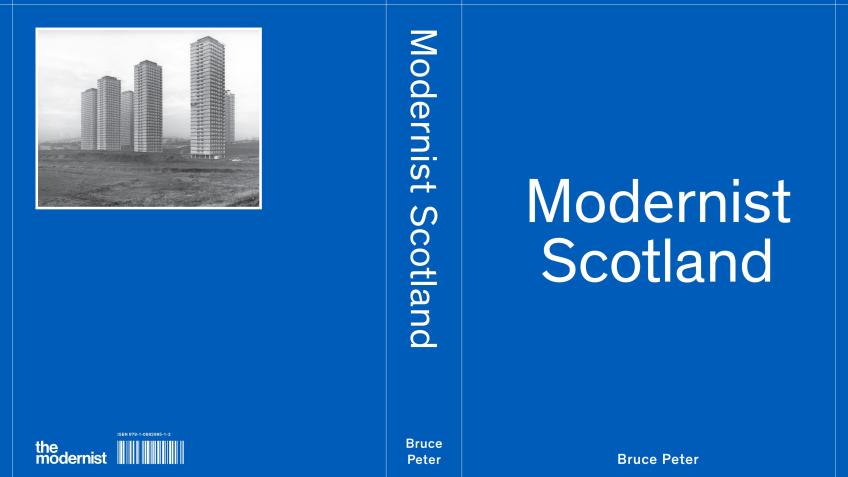
Aim
To publish 'Modernist Scotland' by Bruce Peter—a fully illustrated guide to 150 transformative post-war Scottish buildings.
The book:
'Modernist Scotland'
150 post-war buildings and places1950-1980 by Bruce Peter—a comprehensive, fully illustrated exploration of Scotland's bold modernist legacy.
416 pages; Colour & black and white photographs.
232mm x 177mm

This comprehensive study documents the revolutionary architectural movement that transformed Scotland's built environment in the decades following World War II. Through meticulous research and stunning visual documentation, Bruce Peter examines 150 significant modernist structures that shaped Scottish cities, towns, and landscapes—from pioneering housing schemes and civic centres to innovative educational and cultural buildings.
'Peter understands that modernism in Scotland wasn't some imported Continental affectation but an indigenous mutation, born of post-war optimism and municipal socialism.'
Jonathan Meades
Modernist Scotland aims to be a living history and a manifesto, seeking to encourage greater understanding and appreciation of Scotland’s post-war built heritage and of the many diverse manifestations of the modern movement to have arisen there. This is necessary because since the 1970s many fine post-war buildings and environments have been neglected, unsympathetically altered or destroyed and many more – ranging from very large examples, such the Cumbernauld Town Centre megastructure, to small buildings such as pubs, houses and churches – are at risk.
The book reveals how architects in Scotland embraced modernist principles while responding to local contexts, materials, and social needs, creating a distinctive architectural identity that bridged the international movement with regional character. Each building is presented with detailed analysis, historical context, and high-quality photography that captures both the bold vision of the era and the current state of these structures.
'Modernist Scotland' serves as both an architectural record and a cultural history, examining how these buildings reflected and influenced Scottish society's post-war transformation. This essential volume will appeal to architects, historians, students, and anyone interested in Scotland's built heritage and the enduring impact of modernist design.
The book comprises two parts. Part 1 is a circa 10,000-word illustrated essay, explaining the development of modernism in Scottish architecture, planning, design and culture and emphasising the significance of the country’s post-war built heritage. This is accompanied by never-previously-published illustrations from the author’s collection of modernist buildings and environments, photographed when new and pristine in the 1950s-1970s.
Part 2 contains a survey in chronological order of 150 of the most architecturally and culturally interesting of Scotland’s remaining post-war modernist buildings and places. This comprises new architectural photographs, each with an accompanying text to narrate the subject’s history, significance and aesthetic qualities. A very wide diversity of types of building and place are included with examples relating to popular culture, engineering and technology alongside ones primarily regarded for their architectural qualities.
The design:
'We approached the design of Modernist Scotland with a clear, utilitarian aesthetic that funnels inspiration from both the everyday, local government typography of mid-century Scotland and also the iconic 1965 British motorway design system developed by Margaret Calvert and Jock Kinneir.
This typography is paired with the recognisable blue and white of the national flag to create a design that is both distinctively Scottish and international.' Smallprint Studio
Smallprint Studio, is a collaborative graphic design service based in Manchester working both locally and internationally. Their clients include Tate Liverpool, Manchester School of Art, BAFTA, Orange Art Projects NYC, Manchester Fashion Institute, Southbank Centre and The Holden Gallery.
The author:
Bruce Peter is Professor of Design History at Glasgow School of Art with expertise spanning modern architecture and design across transport, pleasure, and hospitality sectors. His extensive publishing career includes studies of Art Deco hotels and the International Style in the 1950s-60s, research on British Railways design culture, and contributions to major exhibitions on Art Deco architecture at the Sainsbury Centre and V&A.
He continues to publish prolifically with recent works on Danish design influence in Britain as well as Art Deco Scotland, establishing himself as a leading authority on 20th-century architectural and design history across multiple sectors including transport infrastructure, leisure buildings, and hospitality design.
The publisher:
The Modernist Society, a not for profit organisation that celebrates twentieth century architecture and design. Other publications include the modernist magazine (now in its 54th edition); Red Square : Mary de Saulles and the 1960s BEA corporate identity; Modernist Graphic Design in Britain 1945-1980 and Braw Concrete : Post-war architecture in Glasgow.
The rewards:
The book:
The bookmark:
The pin badge:
The prints:
Option 1: Barrowland
Option 2: Fairydean
Option 3: Cumbernauld
Option 4: Lanarkshire Council
N.B. Illustrations of the cover of book and inner pages, bookmark and pin badges are artists impressions - the final articles might look slightly diffferent. Prints offered will be unframed, A2 Hahnemühle Photo Rag (308gsm).
.
This project successfully funded on 27th August 2025