Medical Supercomputers from Waste Electronics
Rotherwas Industrial Estate, England, United Kingdom
Aim
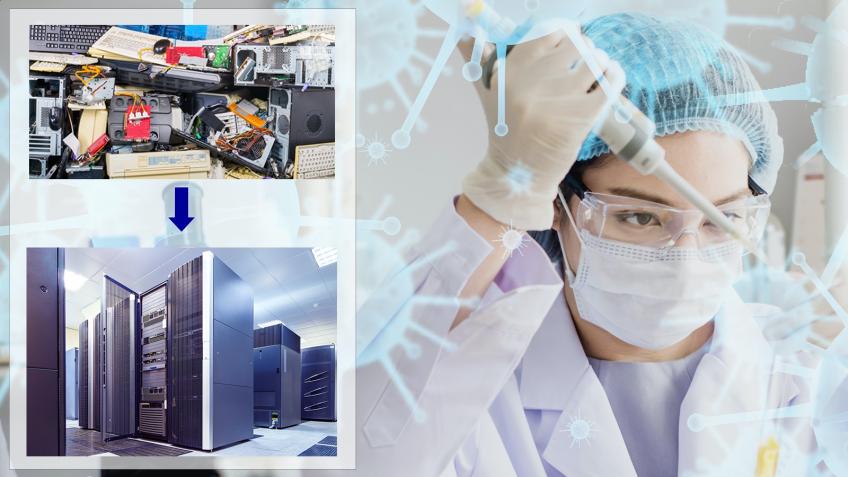
We want to make supercomputers by taking waste electronics from the environment and use them to help find a vaccine and cure for Covid-19.
There are two outcomes we want to achieve through this project:
- The first is to build a prototype supercomputer, that we can then go on to scale-up and duplicate. These computers will be optimised to work in conjunction with other global efforts to find medical breakthroughs.
- The other objective is to build our supercomputer using electronic materials donated to us or salvaged that would otherwise be discarded and contribute to the growing e-waste problem.
Specific Technical Objectives:
- Build 3 supercomputer clusters each with 24 nodes, mostly from donated hardware to act as prototypes to then rapidly build more supercomputers on a larger scale.
- Make it extremely cost effectively: using even the most conservative estimations a 1 PetaFLOPS supercomputer would normally cost around £2,000,000, based on our plan we could do it for less than £50,000 and expect further machines to cost significantly less once we have set up a supply chain for suitable e-waste.
- Power our supercomputers using a carbon-neutral electricity supply.
Note: The current fastest supercomputer in the UK is around 7 PetaFLOPS according to the TOP500 and cost a reported £97m in 2016.
E-Waste
E-waste is the Toxic Legacy of our Digital Age
- Our waste electronics are polluting drinking water and harming ecosystems around the world. It’s time to fix the problem.
- 20 to 50 million metric tons of e-waste are disposed worldwide every year.
- 80-85% wasted - Less than 20% of our e-waste is collected globally, while most of our e-waste ends up in landfills—both at home and in the developing world—where toxic metals leach into the environment.
- Whilst “only” accounting for 2% of landfill, electronic waste is responsible for 70% of overall toxic waste.
- A large number of what is labelled as “e-waste” is actually not waste at all, but rather whole electronic equipment or parts that are readily marketable for reuse or can be recycled.

Ross tells his Story
I’ve been a technology hoarder ever since my Dad started taking me and my brother to local computer markets and the excitement that getting the latest processors, memory and graphics cards gave me made it become an addiction. A feeling that I know is shared by many others, both before me and certainly since.
That was over 30 years ago now, so as you can imagine I had accumulated a lot of “historically significant” technology, along with the latest and greatest advancements, but I had also accumulated some items that were clearly of no value or purpose any longer, mainly through being broken beyond repair. It was when I finally decided to have a clear out and take some things to be recycled that I first started to become aware of how much electronic waste is generated even in a quiet country town like my home town where, at the local recycling facility, I found large containers full of electronics piled on top of each other. I was assured by the site operative that it would all be sent off for recycling or re-purposing but I couldn’t help feel that the crushed, rain-sodden electronics that I could see in that oversized skip would no longer be of much use to anyone as they may have been had they been treated differently. Some quick private research would later confirm that this is a much bigger problem than I even realised.
A short time later I found myself walking past another skip, a private one this time, and I spotted that it had a computer unit in it; then in what seemed to be a cartoon-like double-take on my behalf I noticed that the computer had a label on the front and I said out-loud in shock “is that a Core i7?”, I leant in closer and confirmed that it was. To cut a long story short, I knocked on the door and asked the home owner about the computer and she said for me to “take it if you like, as it is broken”. Never one to turn down a freebie and out of curiosity I did take it and when I got home I opened it up, cleaned and re-seated the memory modules in it and powered it on and it worked perfectly. This made me realise that there must be a very large quantity of computers and electronics that are thrown out well before the end of their serviceable life has ended. Slightly sickened at the ramifications and with a determination to do something about this, it preoccupied me for a few days until (what I feel was) the solution came to me.
I thought: these older computers are perhaps a bit obsolete by themselves, but what if we could cheaply and sustainably band them together to produce dedicated computer clusters for use by medical research? Reliably contributing to the efforts of finding cures for diseases such as Coronavirus and Alzheimer’s whilst at the same time helping to ease the burden of electronic waste on the environment by re-purposing old dis-used computers and GPUs (gaming graphics cards) to create supercomputers.
What is a Supercomputer?
A supercomputer is a computer with a high level of performance as compared to a general-purpose computer. The way this is achieved is by connecting many computers together in some way and co-ordinating them, like an orchestra, to perform tasks together. Systems with a massive number of processors generally take one of two paths. In the “grid computing” approach, the processing power of many computers is used opportunistically, i.e. whenever a computer is available and not performing some other task. In another approach, a large number of processors are used in proximity to each other, e.g. in a computer cluster and are dedicated to the task in a consistent and reliable way.
How Supercomputers can Help
To produce vaccines and medicines, well before any trials can start, scientists need to analyse viruses at a molecular level, their methods of function and simulate any actions those viruses or any potential treatment might take.
In recent times, the advent of more intelligent computing technology means that extensive processing power can be used to help with this scientific research. Some of that research involves using computer simulations to determine or predict the 3-dimensional shapes of proteins, analyse the make-up of proteins in the human body and how they "fold", for example, that may ultimately lead to finding cures for some major human diseases. Misfolding proteins are often the cause for diseases likes Alzheimer’s, Parkinson's, various types of cancer, ALS and more.
Using technology to research these proteins allows scientists to more efficiently and more quickly develop drugs to help combat the issues. This is particularly relevant at the moment with the Coronavirus pandemic. The primary purpose is to model how proteins behave in the body, underpinning so many core biological functions. Those functions include virus infection: research is looking in particular at how the so-called 'spike' of the SARS-CoV-2 virus (which is actually made up of three proteins) attaches itself to human cells and infects the human body. This is the key way that the new Coronavirus can penetrate tissue in the human body, and so blocking it could be crucial to future therapies and treatments. If we can understand more about how the spike proteins work – which is what the computer simulations are doing – then we can better design the drugs to stop them.
If you tried to simulate the opening of the spike on your home computer, you'd be lucky to see even part of the process within the next 100 years, but there is strength in numbers. The magic of using supercomputers for medical research is that it's possible to split up complex protein computer modelling into smaller tasks that can then be distributed to thousands of computers linked together – each computer (or “node”) takes a chunk, runs some calculations and returns the result. The results are then later combined to find an answer or solution. When thousands of computers are working together on a single job the solution is obtained in a fraction of the time, time that could save lives.
Plenty of other Coronavirus-related projects are available too: processing data to assess the effectiveness of potential drugs now being tested in the lab, and to analyse how the Coronavirus controls a cell's machinery after infection. Beyond the Coronavirus pandemic, supercomputers can be used to help process data and simulate molecular interactions that could help cure many infections diseases such as Ebola, Hepatitis C, Zika, Dengue Fever and more; cancers such as Breast cancer and Kidney cancer; neurological disorders such as Alzheimer’s, Huntington’s and Parkinson’s, not to mention epidemiology, meteorology, the search for clean energy, and materials science.
How we will do it
We have a wealth of technical ability and experience in-house but without your help we can’t make this happen.
Firstly, with your financial donations we will create a customised infrastructure of racks and shelves in our existing premises to house the supercomputer clusters as well as market our cause to a larger audience.
Secondly, we will be looking for donations of computer hardware that people no longer want or need that might otherwise find itself in the ever increasing backlog of electronic waste. In particular we are interested in:
- Computers (Home, Business Workstations or Servers) of any age
- Graphics Cards (GPUs) from the last 10 years (nVidia Geforce or AMD/ATi Radeon)
- ATX Power Supplies rated at 500W or greater
- Network Switches (Gigabit or faster)
- RJ45 Network cables
- USB Memory Sticks (4Gb or larger)
At this stage there is nothing better we can do with monitor screens, TVs and printers etc. and having to deal with them might hold us back so please don’t send those.
We will also approach local authorities and various companies in industry that we already have existing relationships with to see how they can help.
Then it will be time to set about sorting through and using the donated hardware (and any additional hardware required should no suitable donation be forthcoming) to create 3 supercomputer "clusters" - one with AMD/ATi Radeon GPUs, one with nVidia Geforce GPUs and a third supercomputer cluster without GPUs - hopefully with 24 nodes in each cluster.
We will then put the supercomputers to work quickly. Initially, to make the biggest and fastest impact they will be joining ongoing supercomputer projects in the form of Folding@Home and Rosetta@Home but we will extend an invitation to other research organisations that may need to use the hardware for furthering medical research (with Covid-19 as a priority).
Beyond this initial goal we will then assess, based on the response by donors and industry how best to proceed in expansion of the project.
Who Are We?
Ross Nicholls (BSc Computer Science) - has been collecting and tinkering with computer hardware since 1987, leading to working as the director of security and communication technology companies solution-providing and pioneering at the bleeding edge of the computer industry since qualifying from Cardiff University with honours in 2004. As a lover of the sea and all things maritime the environment is never far from his mind. Father to three daughters and a dedicated partner, he has a keen interest in using technology to make the world a safer, cleaner and better place now and for future generations.
Caius Hawkins received a master’s degree from the Royal College of Art in Holography, and has had a lifelong fascination with art, music, aviation, invention, technology innovation and sustainable energy. Over the years he worked as part of a small team consulting and solution provider for a range of organisations including Apple, DTI, Australian Commonwealth and SSE plc. Having travelled extensively he is very aware that we are experiencing massive global change which is both positive and negative and believes now is the time for those that can to make a difference.
We ask project owners to honour their rewards wherever possible but please note that all pledges are donations and there is no guarantee that you will receive any rewards from the project owner. Please see Crowdfunder's Terms of Use for more information regarding rewards for pledges.
This project closed unsuccessfully on 21st May 2020