
Worcestershire Heritage, Art & Museums Charity
2nd January 2025Day 32 Update
Good evening everyone!
The team would like to thank you all again for supporting this cause throughout the Christmas Period and for helping to get closer to our stretched goal. We hope your holidays were merry and bright and hope you all have a prosperous 2025.
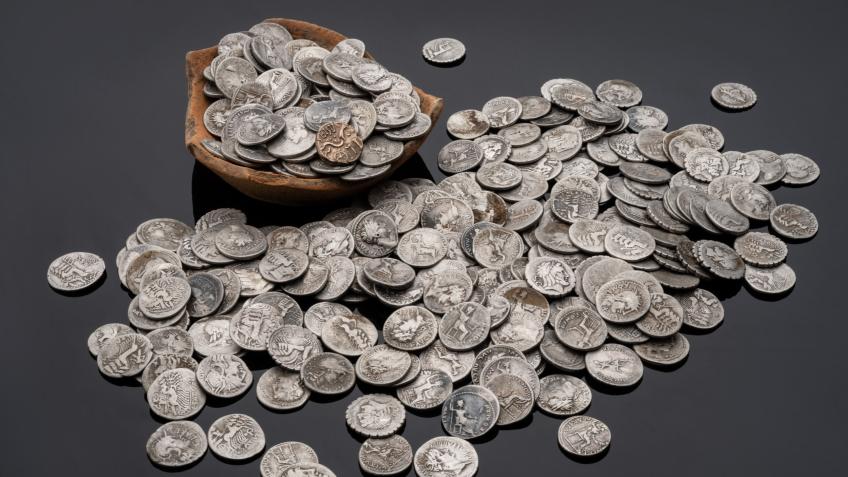
With the new year we wanted to share another piece of research that the Worcester Archive and Archaeology Services have helped us to understand the hoard better by analysing the pot that was found with the Worcestershire Conquest Hoard:
 The outside of the vessel, image Worcestershire Archive and Archaeology Service
The Worcestershire Conquest Hoard is not only made up of coins. There were also 119 sherds of pottery belonging to a single vessel found with the treasure.
The vessel appears to have been broken while the hoard was still in the ground, prior to being found. We know this because the edges of the sherds were found to have worn down and become rounded and were coated in a layer of mud.
The base of the vessel was found intact, but unfortunately the rest of the body was in pieces. There was no sign of the rim of the vessel. The hoard lay buried for two thousand years, so it is very possible that a plough may have clipped the vessel, broken it and dragged the rim away. This sadly means we do not know what the form of the vessel looked like. However archaeologists suggest that it was most likely a pot or jar with a small rim to help contain the coin hoard inside.
Malvern has a rich history of pottery industry spanning back to the Iron Age (~800 BC). Native Britons were originally making grey, rough and handmade pottery but changed their techniques so that they could produce a finer pottery on the wheel, using orange clay, so they could mimic the Roman pottery called Samian Ware. This new Romanesque pottery from Malvern is called Severn Valley Ware and it is very common to find it on Roman archaeological sites in the West Midlands. During the Roman period Worcestershire’s pottery industry grew very quickly. There are 5 confirmed Roman kilns in the Malvern area, but there is a suggestion that there could be more. There are indicators (like surface scatters of pottery waste) which may suggest a kiln was close by, but the actual kiln itself has not been found. The most comprehensive excavation of a Severn Valley ware kiln took place at Newland Hopfields in the early 1990s. Severn Valley Ware pottery from Malvern has been discovered on archaeological sites in North and South-West Wales, all over the Midlands, and even at Hadrian’s Wall.
The fabric of the base, image Worcestershire Archive and Archaeology Service
Without knowing the form in which the vessel took we cannot give this pot an exact date, however, there is a groove on the underside of the base which is a feature that is associated with early production. We can however, date it to the mid-1st to earlier 2nd century, as this pottery is organically tempered. Organic-tempered pottery refers to the deliberate technological act of adding plant-derived material (such as chaff, straw, and dung) to the clay. It is though that this process helped the clay to survive the firing process and become more robust for use.